Weepy Realism
The hazy, historic gaze.

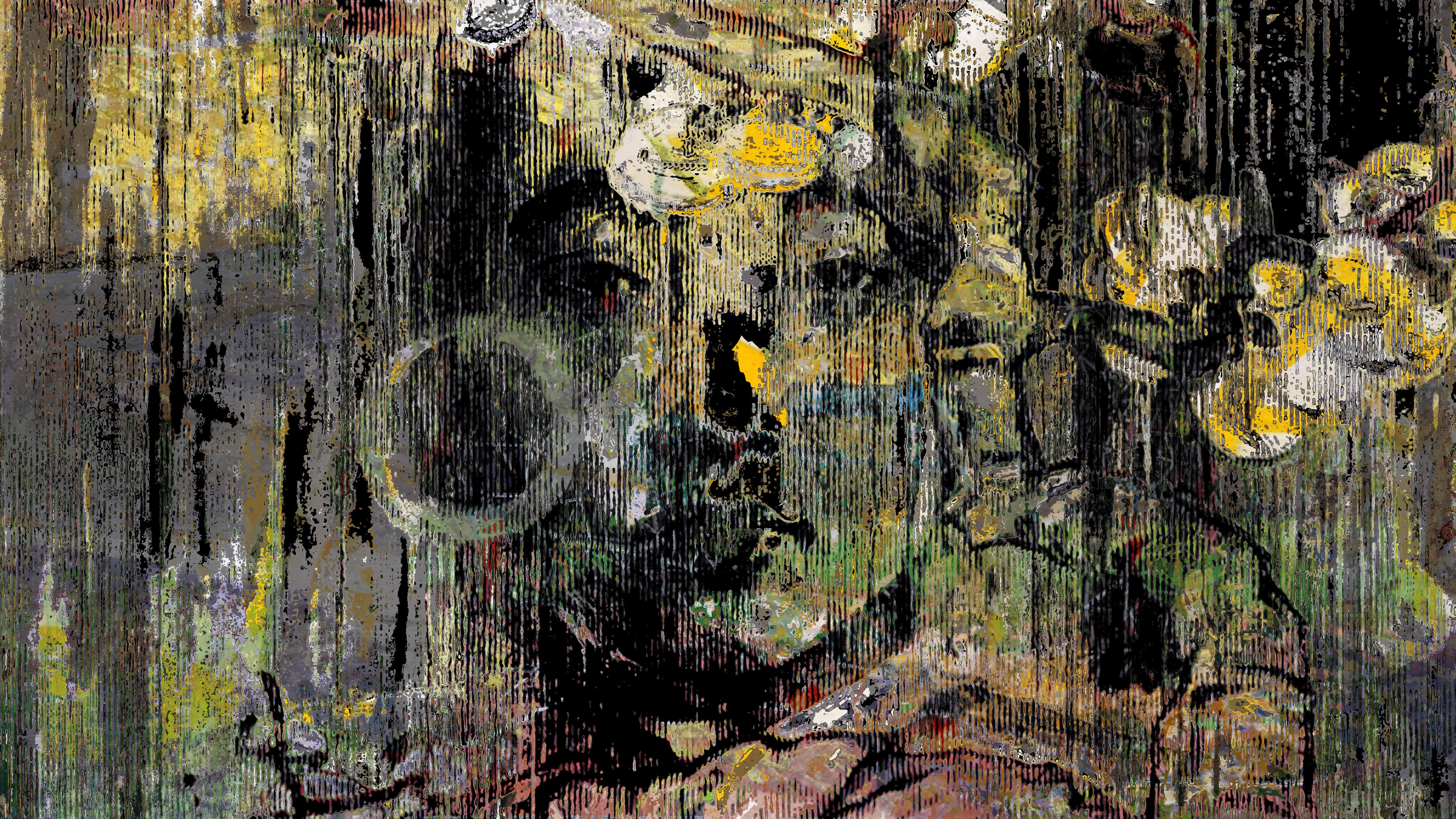
Digital collage based on Hung Liu (b. 1948) "Winter Blossom" (2011)
The Wall Street Journal called Liu “the greatest Chinese painter in the US.”
Hung Liu was born in Changchun, China in 1948, growing up under the Maoist regime. Initially trained in the Socialist Realist style, Liu studied mural painting as a graduate student at the Central Academy of Fine Art in Beijing, before immigrating to the US in 1984 to attend the University of California, San Diego.
Liu subjects historical photographs to the more reflective process of painting. Much of the meaning of Liu’s rich, facile painting comes from the way her washes and drips dissolve the documentary images, suggesting the passage of memory into history. Liu has invented a kind of weeping realism that surrenders to the erosion of memory and the passage of time.
She is Professor Emerita at Mills College, where she's taught since 1990.
Her image here is subjected to these other paintings:
Panca (b.1986) "La Bestia" (2020)
The great cross-border artist, Panca (Paola Villasenor) showed this painting at San Diego's Bread & Salt in her solo show last year just before the COVID lockdown. I was, and remain, entranced by the beast. It's a large painting, the viewer stands toe to toe with it. The netting effect is just complicated enough to be simply powerful, the floating hearts just dumb enough to be funny. She has called her work "Existential Vomit" and I'm sure that's what's coming out of the creature's mouth (and fluorescent, yet!). She's a powerful painter because she goes ahead and does it. There's a Basquiat confidence to her work. She's my favorite local painter.
Vincent Van Gogh (1853 – 1890) “Auvers Sur Oise" (1890)
Vincent left a mental hospital in Saint-Rémy in May 1890 and headed north to Auvers-sur-Oise where several artists were already residing. Vincent spent the final months of his life in this village near Paris. He made new friends and he threw himself into painting the gardens and wheatfields around the village at a feverish rate completing virtually a work a day. His health seemed to be improving, too. From a letter to his brother, Theo, he writes, ". . . knowing clearly what I wanted, I’ve painted another three large canvases. They’re immense stretches of wheatfields under turbulent skies, and I made a point of trying to express sadness, extreme loneliness."
The work from this period, including this one, shows lessons learned from past efforts to simplify and stylize his depictions of the rural environment. He had been attempting to emulate popular Japanese woodblock prints which were, in turn, emulating watercolor paintings. The popularity of these commercial prints in France during the late 19th Century may have led Vincent to speculate that if he could align his paintings with the woodblock print esthetic, his paintings could be popular as well. This proved to be true. Van Gogh's later paintings, the ones with the concentric swirling patterns of strokes are not only his most popular paintings, but are among the most popular paintings of all European art. In this painting and others in his late period, he uses a low-resolution vision of the scene, painting with too large a brush to do detail. He uses strong contrasting colors in rhythmic, concentric patterns of strokes. Nailing down the positions of objects in the scene with heavy, near-black, broken outlines. Beyond merely defining areas in the scene, his brushstrokes set up an overall vibrating visual rhythm that massages the viewer's eyes. We love to be treated this way.
Pierre Bonnard (1867 - 1947) "Nude in the Bath" (1936)
Pierre's wife needed to stay submerged in warm bath water for hours attempting to allay the pain of a skin condition which tormented her. Since he was an observational painter, he kept her company, painting her and the bathroom atmosphere. He made many versions. The late career ones, like this one, were the highlights of a gorgeous, huge MOMA 1998 retrospective of Bonnard that Ruth and I loved.
Alex Katz (b. 1927) "Goldenrod" (1955)
Alex likes his big paintings to be painted direct, with no hesitancies, no overpainting, no corrections. So, he first paints small versions on paper, does his corrections and cropping there. Then, using an overhead opaque projector, he projects an enlarged image on a big canvas. Guided by the projection, he paints with large brushes and few strokes, causing the big painting to effortlessly appear, as by magic.